
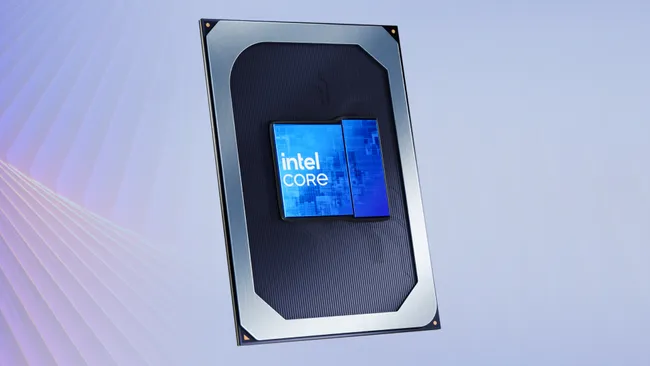
The intricate patterns on an Intel wafer, where billions of transistors are born, now include 2nm-class architectures.
For years, the semiconductor industry watched as rivals pulled ahead in the race for ever-smaller nodes. But in early 2026, **Intel** didn't just catch up; it performed a quantum leap. The official launch of their **3rd Generation 2nm-class processor** (internally known as a refinement of the **Intel 18A node**, or "20 Angstrom" process) marks a pivotal moment. This isn't merely about shrinking transistors; it's about fundamentally reinventing how they're built, powered, and integrated, setting a new benchmark for AI-first computing across every segment.
This new silicon, codenamed **"Lunar Lake-X"** for client devices and **"Diamond Rapids-AI"** for data centers, promises unprecedented performance-per-watt, making it uniquely positioned for the burgeoning AI PC market and the relentless demands of exascale AI training. Let's delve into the hidden innovations that make Intel's 2nm-class process a true game-changer.
I. Revolutionary Transistors: Gate-All-Around (GAA) & PowerVia
The core of Intel's 2nm-class breakthrough lies in two fundamental shifts in transistor design and power delivery.
1. RibbonFET: Intel's Gate-All-Around (GAA) Transistor
For decades, FinFET (Fin Field-Effect Transistor) was the workhorse of advanced nodes. But at 3nm and beyond, its limits became apparent. Intel's answer is **RibbonFET**, their implementation of the Gate-All-Around (GAA) transistor.
- 360-Degree Gate Control: Unlike FinFETs, where the gate only contacts three sides of the fin, RibbonFET wraps the gate completely around the channel. This provides superior electrostatic control, drastically reducing leakage current and enabling much lower operating voltages.
- Variable Width Ribbons: Intel's unique "ribbon" design allows for flexible transistor width optimization. This means they can precisely tune performance and power for different parts of the chip – a critical advantage for integrating diverse AI accelerators alongside traditional CPU cores.
- Performance & Efficiency Gains: Compared to their previous generation, RibbonFET offers up to a 15% performance boost at the same power, or a staggering 30% power reduction at the same performance. This is crucial for both battery life in mobile devices and energy costs in data centers.
2. PowerVia: The Backside Power Delivery Network (BSPDN)
The second, equally revolutionary, innovation is **PowerVia**. Traditionally, power and data signals compete for space on the front side of the wafer, leading to bottlenecks and design complexity. PowerVia moves the power delivery network to the *backside* of the wafer.
- Decoupled Paths: By separating power and signal routing, PowerVia dramatically reduces IR (voltage) drop, leading to cleaner power delivery directly to the transistors.
- Denser Signal Routing: Freeing up space on the front side allows for much denser and more efficient signal routing, which directly translates to faster data transfer and smaller chip areas.
- Enhanced Transistor Performance: This clean power and efficient signaling allow the RibbonFET transistors to operate at their peak efficiency, maximizing the benefits of the GAA architecture.
- Future Scaling Enabler: PowerVia is seen as critical for scaling beyond 2nm-class nodes, laying the groundwork for future Angstrom-era processes.
II. Chiplet Integration: The Forging of a Superchip
Intel's 2nm-class processors are not monolithic. They are sophisticated assemblies of chiplets, interconnected by advanced packaging technologies.
1. Foveros Direct & EMIB Advances
Intel's advanced packaging solutions, **Foveros Direct** (for direct die-to-die bonding) and **EMIB (Embedded Multi-die Interconnect Bridge)**, have been refined for the 2nm era.
- Heterogeneous Integration: These technologies allow Intel to mix-and-match chiplets manufactured on different nodes or even by different foundries. Imagine a 2nm CPU tile alongside a 5nm GPU tile and a specialized 7nm AI accelerator.
- Reduced Latency: Foveros Direct enables sub-micron interconnect pitches, creating connections so dense and short they behave almost like a single piece of silicon, minimizing latency between chiplets.
- Cost-Effectiveness: Breaking up a large, complex chip into smaller chiplets (some on cheaper, older nodes) significantly improves manufacturing yield and reduces overall cost, making these advanced processors more accessible.
III. Impact Across Industries: AI, Mobile & Beyond
The 3rd Gen 2nm-class processor is poised to redefine several key technological landscapes in 2026.
1. AI PCs and Edge AI
The **"Lunar Lake-X"** for client devices is a beast for on-device AI. Its extreme power efficiency means complex LLMs, real-time generative AI, and advanced neural processing can run directly on your laptop or smartphone without draining the battery. This marks the true era of the **AI PC**, where local AI is as fundamental as the CPU.
- Always-On AI: Low power consumption enables continuous background AI tasks like advanced noise cancellation, predictive assistance, and hyper-personalized experiences.
- Enhanced Security: Running AI locally keeps sensitive data on your device, bypassing cloud privacy concerns for critical applications.
- New Software Ecosystem: Developers are rapidly adopting Intel's OpenVINO and other AI toolkits to leverage these new local AI capabilities.
2. Data Centers and Supercomputing
The **"Diamond Rapids-AI"** lineup for servers pushes the boundaries of data center efficiency and AI training. Its superior performance-per-watt reduces operational costs and carbon footprint, critical for large-scale deployments.
- Exascale AI Training: Enabling faster training of multi-trillion-parameter models with fewer servers.
- Sustainable Computing: PowerVia and RibbonFET contribute directly to lower energy consumption, aligning with global green computing initiatives.
- Hybrid Workloads: Unparalleled performance for both traditional HPC (High-Performance Computing) and new-age AI workloads.
IV. The Road Ahead: Intel's Foundry Ambitions
The success of the 2nm-class process isn't just about Intel's products; it's about their broader vision as a foundry.
Intel Foundry Services (IFS)
With the "18A" node now mature and in volume production, **Intel Foundry Services (IFS)** is aggressively courting external customers. This directly challenges TSMC and Samsung, aiming to diversify the global semiconductor supply chain.
- Geopolitical Significance: A strong IFS provides a crucial Western-based manufacturing alternative, mitigating geopolitical risks.
- Diverse Portfolio: IFS is attracting major players from defense, automotive, and cloud computing, eager to tap into Intel's advanced packaging and process technology.
- Innovation Loop: External customers bring diverse design challenges, accelerating Intel's own process development.
